.gif.09c9795f713c10c309d68122b089d26c.gif)
DARKNESS
-
Posts
2381 -
Joined
-
Days Won
19
Everything posted by DARKNESS
-
.thumb.gif.4a8d59f41391d88092e62269cfe1e7ec.gif)
support Low speeds on Ethernet and Wifi despite updates.
DARKNESS replied to BigPapyto's topic in Netduma R3 Support
@BigPapytoIt’s likely an issue with your Ethernet cable. Try replacing it with a new one or using a different cable to check if the problem persists. Don’t use the same cable. I would guess you’re using the one that came in the package, which some came faulty. Just something to point out....they may work as intended but randomly do drop to 100Mbps instead of using full throughput due to bad coiling, etc. -
Black ops7 Servers Not Showing in Geo-Filtering (XR1000) + Error
DARKNESS replied to rash's topic in Netduma R3 Support
@rash You're not going to be able to use PingHeatmap for that at the moment, as it appears to be down. Instead, you can use GeoFilter and select Black Ops 6 servers since Call of Duty often reuses the same server locations. Regarding firmware, you can upgrade to the latest patch using the following link. However, make sure to check the back of your router for its specific variant (e.g., RCN, Grande, etc.). If it doesn't match the description, type the model into the search bar on Netgear's website, and it should provide the correct firmware. https://kb.netgear.com/000070336/ -
Anyone else having this problem daily?
DARKNESS replied to Rodolfo Lima's topic in Netduma R3 Support
@Rodolfo LimaWhen you connect directly through your modem, you get the correct speeds, but when connected to the R3, the speeds are not as expected. This issue could be related to the DPI misdetecting something and prioritizing it incorrectly. To address this, try disabling SmartBoost and application detection classifications to see if you achieve the correct speeds. -
Anyone else having this problem daily?
DARKNESS replied to Rodolfo Lima's topic in Netduma R3 Support
@Rodolfo LimaAre you using PPPoE or DHCP? It could also be due to congestion. While getting 90 Mbps isn't too bad, it is still a reduction, though not one that would significantly impact your experience. However, if you're noticing high latency during this time, that would be more concerning. -
Anyone else having this problem daily?
DARKNESS replied to Rodolfo Lima's topic in Netduma R3 Support
@Rodolfo LimaYou’re aware that the speed test Sony uses is highly inaccurate, right? The reduced speeds are likely due to the rules you've configured or being activated by the DPI rules etc. -
xr1000v2 beta firmware
DARKNESS replied to dav581005's topic in NETGEAR Nighthawk Support (XR range)
@dav581005If you check the first page on the XR1000 beta testing group, the initial topic makes it clear—honestly, I wouldn’t recommend upgrading. It’s better to stick with the public firmware for now, as there’s clearly an issue preventing upgrades or downgrades. Until they resolve the problem (assuming it’s even fixable), it’s safer to avoid the beta version. Netgear released security patches a few months ago. If you’re using the XR1000V2 model, be sure to choose the correct version, as there are several variants available. There's the link to the V2 model https://kb.netgear.com/000068349 -
@Tasharocki He makes a valid point. Anyway, since you claim to be a tech IT expert, I’m confident you can download and use an extension. Please use the following extension to show us what you’re seeing. You can even communicate through the extension if that’s more convenient for you. I’m not saying you’re wrong, but this could save you time waiting for a replacement if the issue is due to incorrect setup. To make everything clearer, adjust the web zoom range to either 50% or 67%. https://chromewebstore.google.com/detail/jam/iohjgamcilhbgmhbnllfolmkmmekfmci?hl=en-US
-
@TasharockiIf you're trying to prove a point, consider showing a video for better clarity. In the image you shared, it's not clear whether the speed test bypass is disabled. Additionally, it might appear disabled, but due to a caching issue, it may not be accurate. Clear your cache or try using incognito mode and check again.
-
@Reykc9510Well, now you have your answer! Here's a clip—you just had to right-click. It took me some time to make this video since I decided to create just one to save people some time. I’ll probably upload it to YouTube later, but I’m trying to fully master Final Cut before doing so. This is my first video using Final Cut, and while it was a bit confusing, I noticed the text doesn’t look as sharp. That’s another thing I need to figure out as I continue learning. https://drive.google.com/file/d/1zxFC5SWcTFMU4FPgFXIPj09F4FBrHVVn/view?usp=sharing
-
@Reykc9510My point is that you're likely playing on different servers. If your in-game ping averages around 20ms and only fluctuates up to a maximum of 25ms, that's normal. However, if it spikes to 40-60ms, that indicates an issue. Jitter is pretty obvious when it's a problem, as it causes noticeable spikes. If the problem originates from the game server instead of your network, your best option is to try playing on a more reliable server. Although ISP congestion might contribute, it usually has a minimal effect and is ultimately beyond your control. You can share more data, and someone else might review it tomorrow and provide suggestions. For now, I’m heading to bed, mate. If you can’t create a URL, just take a screenshot on your desktop or use SnapTool since you’re on Windows.
-
@Reykc9510The area you’re in contains multiple servers, and since your radius encompasses them, your connection will default to whichever server is available. This can lead to varying ping rates across different servers. Based on your observation about nighttime, it’s reasonable to assume SBMM (Skill-Based Matchmaking) might be more active during peak hours, typically between 6 PM and 12 AM, when the majority of users are online, especially in North America. To minimize high ping, you should identify the server with the lowest ping and adjust your radius to focus on that specific server. Using a polygon for precision would be highly effective. Call of Duty is notorious for its rigged SBMM, much like Apex Legends.
-
@Reykc9510I'm referring to the URL link provided by the website. You don't need to click on "View Share Image"; only the site's URL is required. If you're the sole user, it might be related to the game server. What game are you playing? Are you using a geofilter to connect to the nearest server etc... Ensure you're using the latest version of PingPlotter, as I recall there was a bug affecting file sharing or exporting. Did you purchase a perpetual license, or were you using the free trial at that time? That could be the reason.
-
@Reykc9510 It’s possible that when the network is under heavy load, meaning everyone is using it, you are likely spiking well above that consistently because your QoS isn’t properly adjusted. Note that for example, if a URL is loaded, it will show a high spike, and that's normal, so if you are testing for your QoS load, load the URL before starting the test. I know I am talking about the target route that one's far away usually. https://www.dropbox.com/scl/fi/vblyg3nutvyo3o84nkpd3/Screen-Recording-2025-10-15-at-7.53.02-PM.mov?rlkey=7ull6883ttiw0ecmrhld72ocf&st=e0rqy6rb&dl=0
-
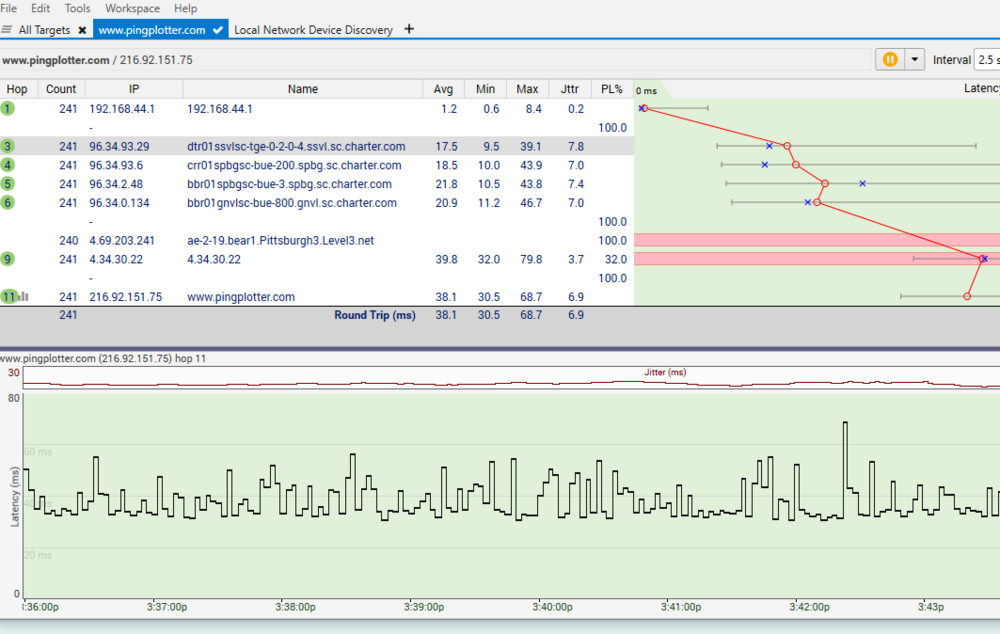
@Reykc9510You didn’t enable the maximum latency option—it’s a hidden feature. Try double-clicking to reveal it. What do you mean it doesn’t let you share the link? You should be able to generate the link by selecting “View Image,” “Share Link,” or directly using the URL. It’s subtle, but there aren’t any abnormal jitter spikes. If there were, you’d notice a series of spikes instead of a straight line. While the pro version displays the exact numbers, you can still interpret the graph visually without them. A clear example of poor jitter is consistent spikes exceeding 30ms, as shown in the screenshot below. Avoid using pingplotter.com; as the routing hop it’s just an example.
-
@Reykc9510 I mentioned PingPlotter; I'm not sure how you ended up with "ping blotter." You've used PingPlotter before, based on your previous post. https://www.pingplotter.com/products/free/
-
@Reykc9510 You're creating a new topic for the same issue, but I want to highlight that using Waveform as your jitter test is not a reliable measurement tool. It doesn’t provide details about server locations, so you might end up testing a server far away—potentially 1,000 miles—which could distort the jitter results. The most accurate approach is to use PingPlotter. When testing, share a screenshot of your graph while your network is idle, ensuring there’s no activity for at least 5 minutes. Enable maximum latency on PingPlotter to get a clear view of your network performance. To create a shareable link, click "File," then "Create Share Page," and follow the steps. Use google.com as the test target for better accuracy. Remember, not all technicians are highly experienced—many rely solely on the tools provided by their company and may overlook complex issues. Often, effective troubleshooting falls on you unless the problem is easily detectable.
-
@fdsThey no longer use a limiter; previously, DumaOS 3 featured a dedicated limiter, but it proved to be highly inefficient. Instead, they have shifted to using reserves, which, in my opinion, still lack effectiveness. Reserves essentially allocate bandwidth for a specific application or the maximum possible during usage when applied. On a side note, if a game isn't detected by SmartBoost, I recommend switching to "always," as some games are unsupported or have outdated DPI. In such cases, congestion control won’t activate properly since it relies on SmartBoost to enable congestion management, but having it on always essentially mitigates that issue, so it is preferred but it a preference. The admin will be available tomorrow if you need further assistance or today.
-
@fds By monitoring the game during the bufferbloat test, you can detect abnormal spikes or packet loss. If such issues occur, continue fine-tuning the settings. The goal of SQM (Smart Queue Management) is to optimize the network, prevent overloading, and maintain consistent latency. Every connection is unique; for instance, my connection has 2G download and 400 Mbps upload speeds. To ensure stability without packet loss, I adjust it to 180 Mbps download and 60-80 Mbps upload. This setup consistently earns me an A+ rating, even during ISP congestion. Throughput is less critical for gaming; latency and stability are the key factors. While other elements may influence performance, the most important ones are within your network, which you can control. It seems that you want full throughput when you're not gaming, which is achievable through the router settings. Simply select the low latency option, and it should only be activated while gaming, if I recall correctly.
-
@fdsWhen performing these tests for bufferbloat, ensure you follow the instructions correctly, such as connecting directly to the LAN and ensuring no one is running any background activities, as this could introduce margins of error. It’s not entirely necessary to cap your speeds, but if you want the best experience with no packet loss or latency increase in-game, where it’s most noticeable, it might be worth considering. From my understanding, FC26 isn’t necessarily a hit registration game, plus I don’t play those types due to their “pay-to-win” nature—but to each their own. To see this in real-time, perform a bufferbloat test while playing the game. For your specific game, go to Settings, select Visuals, and enable Connection Monitoring. Follow the instructions provided in the video. I mention this because of the placebo effect—you want to ensure you're observing actual results, not influenced perceptions. - https://www.youtube.com/watch?v=4q_-afXn-8U Which firmware version are you currently using? Are you saying that congestion control keeps you from dropping below 50%? You can easily adjust the speeds in Speedtest Advanced to achieve the same outcome.
-
@fdsYes, that's normal; that's what QoS does. It manages your packets to prevent any queue buildup. What do you mean by "slayers"? You don't need more than 5 Mbps to play a game.
-
@Reykc9510It should be straightforward to verify—schedule a tech appointment for the time the issue arises and demonstrate it using PingPlotter reports connected directly to the box, unit, ONT, or modem. How are you measuring jitter exactly?
-
@18RayF A reset will not resolve the issue. Instead, try disabling the device on the Geo-Filter or identify the relay server by monitoring the Geo-Filter while connecting to the servers. Once you identify the relevant servers, either allow them or create a precise polygon around their location. This is recommended as there are typically multiple servers within the same area, and manually allowing each one repeatedly would be time-consuming. If you're not using a geofilter, the issue is likely unrelated and could instead be due to drivers or a NAT problem, though that is rare. The admin will be available tomorrow for further assistance.
-
@18RayF If it's happening every day, then you're likely blocking a relay server with the geofilter. If it just started happening recently, it's most likely a server issue on Battle.net's end.
-

-
.png)